
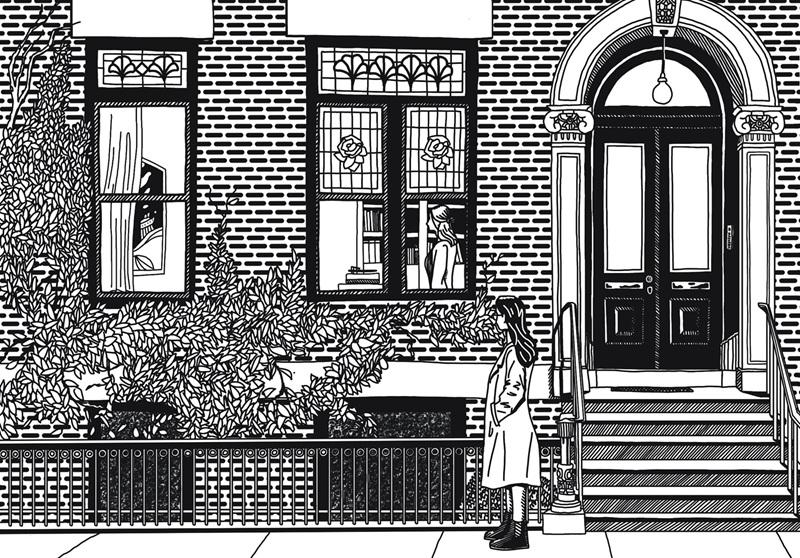
MARLBOROUGH STREET was a dream. Sylvia met me in front of Women’s College Hospital after her shift, and then we took the bus up to her house in Rosedale. I had heard of the houses there – old Toronto homes from the 1900s, or maybe even older, still standing in all their architectural glory – but hadn’t prepared myself for what I saw when we stepped off the bus.
On Marlborough Street stood three-storey red-bricked houses, with arches over the front doors and pointed towers peeking out from the roofs. Green ivy snaked up the sides of homes and across stained-glass windows, and white wispy curtains shielded homeowners just enough from the curious eyes of passersby. As we walked down the street, I saw shadows of those people in the windows of their front-facing sitting rooms: clinking glasses, playing records, reading books. Others ate with their blinds open, and sat underneath chandeliers filled with Edison-style lightbulbs. They looked as if they were having seductive and peculiar conversations. I know I would feel compelled to have those, if I was the one inside.
Sylvia rented a house with three other girls. It was really a three-bedroom house, but one of the rooms was big enough for two of the girls to sleep in, so they squeezed in a fourth to make the rent cheaper. They had a big living room that overlooked the street, and the wispy curtains that everyone else seemed to have to shut out the Peeping Toms. The kitchen was small, and there was a sitting room at the back of the house, overlooking a garden. A grand staircase wrapped its way upstairs to the bedrooms, and a smaller one led to a turret on the roof. It was too small of a room for anyone to stay in, so the girls used it for storage.
I loved visiting Sylvia. It was a nice break from the busyness of downtown Toronto, and from the suburb and rooming house I lived in far from town. The subway ride between Rosedale and Warden was long and uneventful, but knowing I was about to visit Sylvia in her big, beautiful house, or that I was coming back to my single room with the memories, made the trip worth it. A few times during my residency I asked about her roommates – what their plans were, if they were thinking of moving out soon – and received a shaken-head no.
“They like it here,” Sylvia said one time. “Not just the house, but the city too. And Women’s College is a great hospital. You should try to transfer!”
“Michael Garron isn’t bad.”
“Sure,” Sylvia said. “But then you’d be closer to me!”
It wasn’t like I hadn’t thought about it. I knew she was joking, but I didn’t know myself if I would be transferring for the experience at Women’s College, or to be closer to her.
I MET SYLVIA IN MEDICAL SCHOOL in Ottawa. We had a few mutual friends in common, but only the two of us had decided to do our residencies in Toronto. We weren’t too close at the time, but it was nice to have a familiar face in a new city. When she found out I lived so far out on the subway line, she started inviting me over to Marlborough.
Sylvia had bouncy blonde hair that she styled like Sylvia Plath’s. (“My parents named me after her,” she said, in one of our first conversations. “Isn’t that ominous? Did they think I was going to grow up suicidal?”) She was smart as anything, and in med school she was the one to ask the teacher the most probing questions about whatever we were learning that day. I don’t think she was ever in a bad mood, even when she was stressed about school or working at Women’s College. She’d channel it into the times we all met after our shifts, when we were overtired and too buzzed to sleep, when we played cards, drank wine and laughed about the people we worked with and the men in our lives. In the sitting room, the big bay windows let in the fading evening light, and scattered table lamps carried the glow into the darkness.
Marlborough felt like home to me. Things seemed dreamier and more romantic there. I could forget about the illness and pain I was witnessing during the day, and pretend I was an heiress or war widow whose only interest was to debate current events with her friends over tea. That was all we really did when we were together, anyway.
ONE NIGHT, during a game of euchre, Sylvia asked, “Anyone thinking of getting married?”
“To who?” asked Molly, one of Sylvia’s roommates. I had seen her a few times in some classes, but hadn’t known her very well until now. She was kind but direct, never letting anyone catch her off-guard. I respected that about her.
“Charlie Hicks?” Sylvia said, then burst out laughing.
Molly made a face. “He’s dumb as a bag of sticks. I still don’t think he could tell the difference between a male and female cadaver without someone outright telling him.”
“Yeah, I’ll pass,” I said.
“He won’t,” Molly added. “Pass residency, that is.”
We all laughed. But I held my cards tighter in my hand. I looked at Sylvia, who was studying her own cards, her mouth twisted to her right as she thought about her next move.
“Why are you asking?” I said.
Sylvia shrugged, her eyes still down. “My mom asked me on the phone today. I thought it’d be funny to ask you guys, too.” Now she grinned. “Just wondering if there were any updates.”
“There’s no one really that interesting in my group,” Molly said. “I’m going to have to look elsewhere.”
“Yeah,” I said. “Same with me.” But I kept my eye on Sylvia, on the scrunch of her mouth that came back as she focused on her cards. Her blonde hair glowed in the orange lamp light behind her. When she looked up, she smiled at me.
SUMMER ROLLED AROUND, and Sylvia took a week off to go camping in Algonquin Park with her family. It was the longest week of my life. I was still on shifts, and hadn’t taken any vacation yet – how could any vacation compete with spending my overtired nights at Marlborough? But going straight home after working twelve straight hours was miserable. Again, I found myself wondering whether I should transfer hospitals, and why I was even thinking about it. I fell asleep immediately after my shifts that week, dreaming about the warm hug of the Marlborough house, its breezy bay windows, the smell of red wine and Sylvia’s brilliant smile. The hot days stretched out into nothing in the city. Every day I woke up, I wished I could grab the evening and pull it closer to me like a big duvet, covering my head until Sylvia returned.
When she did come back, Sylvia called and asked if I wanted to meet her before her next shift. We went to Chinatown and got late-night (or maybe it was early-morning) Chinese. She told me about her time canoeing on the lake, building bonfires with her siblings and pitching their food up into a tree so it didn’t attract bears. I listened with pure fascination, and watched her eyes light up and dart around excitedly as she talked.
“You should come with us next time,” she said. “We usually do a weekend in the fall, over Thanksgiving. The trees are so pretty, then.”
“I’ve never camped in my life. I don’t know if I’d be able to handle it.”
She waved her hand at me. “It’s nothing. I’ll show you the ropes. And I’ll keep you away from my brother in case he tries to watch you change.”
I laughed, but as we continued our conversation I realized I didn’t care if he saw me changing. I’d care more if Sylvia did.
WHEN AUTUMN CAME, Sylvia did invite me to camp with her family, but I couldn’t go: the hospital needed me to stay and monitor some patients. I was a bit relieved, if I was being honest with myself. I had never met her family and I didn’t know how to act around them, or how I’d act spending a weekend away with her. Though I tried not to think of it like that.
When she came back, the Marlborough nights returned. We had our usual card nights and gossip sessions in the living room, and towards the end of one night I drank a little too much. I was sitting beside Sylvia on the couch and peeking blatantly at her cards as we played, prompting her to call me out for cheating every few rounds. At one point, I leaned over so obviously that it made her drop them. She shrieked at me, and the whole room erupted in giggles and boos.
“Someone can’t handle their liquor!” said Linda, another one of Sylvia’s roommates. She helped us pick the cards up off the carpet.
The game continued; Sylvia made a face at me. She was sitting beside the lamp with the orange light again, and it lit up half her face in the softest way. Without thinking, I put my drink on the coffee table and my hands on her shoulders. Then I said, “You’re gonna win this round. I know it.”
She looked at me, puzzled, but she didn’t look away. “Well, maybe not after what just happened . . .”
“No,” I said, and cupped her soft, orange-blurred face in my hands. I couldn’t help myself. “You’re gonna win. I know it. I know it.”
“Okay,” she said, smiling. “Okay, I’ll try.”
I wasn’t thinking about the others in the room. I stayed like that a long time, so I could remember how her face looked in my head forever. Then I picked up my drink and slumped back against the couch.
It hit midnight, and we all started to clean up before calling it a night. I brought my wine glass and an empty bottle into the kitchen. Sylvia was at the sink, putting the glasses and other dishes inside. When I put my glass on the counter beside her, she turned and put her hands on my shoulders, just as I had done earlier.
“I didn’t win,” she said, shaking me a little bit, but she was smiling. “I didn’t win, but that’s okay, because I won everywhere else. With all of you girls,” she said, looking around at her roommates.
“Boo!” Molly called out from the living room.
“She loves to be a sap,” Linda groaned, as she carried in more empty bottles.
“It’s true!” Sylvia said, her hands still on my shoulders. She cupped my face as I had hers before. “Where would I be without you?”
I smiled, then quickly excused myself to the bathroom. My face was burning.
Once the living room was cleaned up, Sylvia offered me a drive home. I said goodbye to the girls and got into her rental car; the two of us chatted non-stop on the long drive out to Warden.
At a stop light, she suddenly said, “My parents are setting me up with someone.”
“Oh, really?”
She nodded. “Someone they’ve known for a while. Family friend. I’ve never met him though.”
“Huh.” I started fidgeting with my fingers, picking at my nails. “When are you meeting him?”
“This weekend, I think.”
“I hope he’s not a dud.”
“I don’t think he will be.” Sylvia kept her eyes on the road. “I trust my parents. They usually know what’s best for me.”
“Sure,” I said. “You know them better
than I do.” It was supposed to come off as a joke, but Sylvia didn’t laugh.
“It might be nice to be married someday,” she said instead. “It looks nice.”
“You’re already thinking about marrying him?”
“I don’t know. But I think it’d be nice, eventually.”
“I haven’t really thought about it.”
“A lot of girls I work with do.” She turned the wheel and the streetlights dotted white over the windshield.
“Yeah,” I said. “I guess we’re at that age.”
“I can ask if he has a friend, if you want,” she said, looking over at me. “We could double-date.”
“Yeah, maybe,” I said.
The rest of the drive was quiet. I looked out the open window as we sped down the parkway. The trees blurred together in the dark and the air was cold on my skin. As I closed my eyes, I wondered how I could know the person beside me so well and yet not at all.

Maia Kowalski (she/her) is a writer from Toronto, Canada. She has been published in Flash Frog, ellipsis… literature and art, White Wall Review, and Montreal Writes, among others.