
IN THE FALL OF 1942, with the Second World War raging, my father wanted to join the fight. But Doug Clark was six months shy of his eighteenth birthday and required parental permission to enlist in the Canadian military. His father turned him down flat. “Don’t even think about it,” Alexander Clark told his son.
Alexander knew the horrors of war. He had served as a machine-gunner in the First World War. But when he rejected his son’s request, he was almost certainly thinking about another teenager, his kid brother who never lived to see his eighteenth birthday.
Douglas Clark, for whom my father was named, died in the Great War at age seventeen. He was killed four days before the epic Battle of Vimy Ridge. And, according to the family story passed down through the generations, it was Alexander who unwittingly set in motion the events that led to his brother’s death.
FOR SHEER BARBARITY, the First World War staggers the mind. But try to imagine this:
For days on end, you live in a waterlogged trench, a morass of rotting bodies and human waste. You are constantly fending off giant rats. You are driven mad by lice, scratching yourself until you bleed. Enemy snipers in their own trench pick off your friends. Exploding shells shake the earth.
During lulls in battle, you contemplate the abhorrent futility of a war in which thousands of soldiers die to gain a few hundred metres of ground, and then thousands more die when the enemy counterattacks and retakes the land.
And yet, despite your terror, when ordered to attack (“Over the top, lads!”), you obey. Because to refuse could mean being shot for cowardice.
Clambering out of the trench into No Man’s Land, you encounter a scene that is the stuff of nightmares: a pulverized, treeless mire filled with shell craters, barbed-wire coils and decaying corpses. The smoky air seethes with machine-gun bullets. Shells rain down, throwing up great clots of mud. Weighted down by equipment, you slog through the boot-swallowing muck. All around you, your comrades are being cut down. The wounded writhe in agony, screaming for help. Soldiers hopelessly tangled in barbed-wire barricades are slaughtered by enemy fire.
Now imagine a boy in the midst of this hellscape.
ON FEBRUARY 17, 1916, a teenage boy with dreams of joining the army walked into the Toronto recruiting depot and told a lie.
Douglas Clark was a skinny kid – five foot five, 119 pounds – with fair hair and hazel eyes. He lived at 203 Oak Street in east-end Toronto. At sixteen, he was too young to enlist. So he claimed to be seventeen and a half. But even at that fictional age, he still required parental consent, which he probably received from his father, William Clark.
It’s likely the recruiters at least suspected that this eager, fresh-faced boy was fibbing. But the army needed soldiers and there were quotas to fill. Young men in Canada were subjected to a constant drumbeat of patriotic messages to join the war effort, and the military didn’t seem to care if boys were swept up in the excitement. Birth certificates were not required to enlist. If someone like Douglas had visions of a grand war adventure, no one disabused him of the notion.
And so, Douglas was welcomed into the military, joining his brothers, Alexander, twenty, and William Jr., eighteen, both already overseas.
After three months of training at the CNE grounds, Douglas sailed for England aboard the S.S. Olympic (Titanic’s sister ship), which had been converted into a troop transport. Arriving on June 8, 1916, he underwent more training, and marked his seventeenth birthday on July 24, pretending it was his eighteenth. As far as the army was concerned, he was now old enough to fight.
The following month, Douglas neatly wrote his will in his pay book, leaving his “property and effects” to his father. He couldn’t have had much to leave. For service to king and country, he made $1.10 a day, and had already arranged for $20 a month to be sent to his father.
Assigned to the First Battalion, Douglas was shipped to France, joining his unit on a rainy day in early October and getting his first taste of trench warfare: the mud, the vermin, the deafening bombardments, the stench of death. It’s unlikely he was the only boy in the battalion. War historian Tim Cook says that as many as 20,000 underage Canadian soldiers served overseas in the Great War, and that more than 2,000 of them were killed.
The Battle of the Somme had been raging for months when Douglas arrived. Historians have struggled to find words to describe the brutality of this battle, using metaphors like meat grinder and charnel house. On the first day of fighting alone, July 1, 1916, 19,000 British soldiers were killed.
On October 5, according to the battalion’s war diary, Douglas and his mates dug trenches all night in the churned-up mud while under fire from high-explosive shells designed to spray shrapnel. There was more digging the following night.
They moved to the front line on October 9. That night, a rescue party ventured out into No Man’s Land and saved five wounded soldiers. A German sniper killed a sixth man while he was being placed on a stretcher.
The next day, as recorded in the diary, a German prisoner was interrogated, warplanes droned overhead and several Canadian shells fell short near the front line.
And then, Douglas’s brief baptism by fire was over. His battalion pulled up stakes and began a two-week march through the French countryside to the next battlefield. The soldiers trudged west, then north, detouring around a bulge in the Western Front. They found shelter where they could along the way and stopped on occasion to train.
On October 24, they arrived at Vimy and moved into the front lines five days later. Rising above them was the ridge, its muddy slopes littered with the bones of thousands of soldiers who had already died fighting over the seven-kilometre spine of land. Looking down on the new arrivals were the Germans, who had turned the strategically important escarpment into a stronghold of trenches, barbed-wire barricades, machine-gun nests and concrete dugouts. French and British forces had failed to push the Germans off the ridge. Canadian soldiers would be the next to try. By the end of 1916, 100,000 Canadians were spread out along the base of the ridge, a veritable city of soldiers.
Douglas and his comrades settled in for a long winter. They manned the front lines, dug trenches, raided enemy positions and underwent training. The two sides regularly exchanged artillery fire.
On Christmas Day, while resting behind the front lines in the village of Diéval, the soldiers of the First Battalion played football and had a “special” dinner.
By March 1917, the battalion was training almost every day, rehearsing its role in the meticulously crafted battle plan to seize the ridge. In early April, the Canadians unleashed a torrent of shells on the hilltop. The Germans responded with their own barrage. The pounding went on for days, driving some soldiers mad.
By this time, Douglas and his mates were manning the forward trenches near the south end of the ridge.
Somewhere nearby, Alexander Clark, a Fourth Brigade machine-gunner, was taking part in last-minute training. He had been fighting in Europe since June 1916, all the while apparently unaware that Douglas had enlisted. It’s unknown exactly when or how he found out. Perhaps a friend or family member wrote to tell him. There’s a small chance the brothers encountered each other at Vimy. Whatever the case, determined to protect Douglas, Alexander alerted military officials about the underage soldier.
So, four days before the planned attack, Douglas was ordered to leave the front. What the army planned to do with him is unknown. A job might have been waiting for him at the rear. He might have been sent back to England for more training. Perhaps he was on his way home.
Wherever he was headed, he didn’t get far. On April 5, 1917, Douglas was killed by a German shell while leaving the forward trenches.
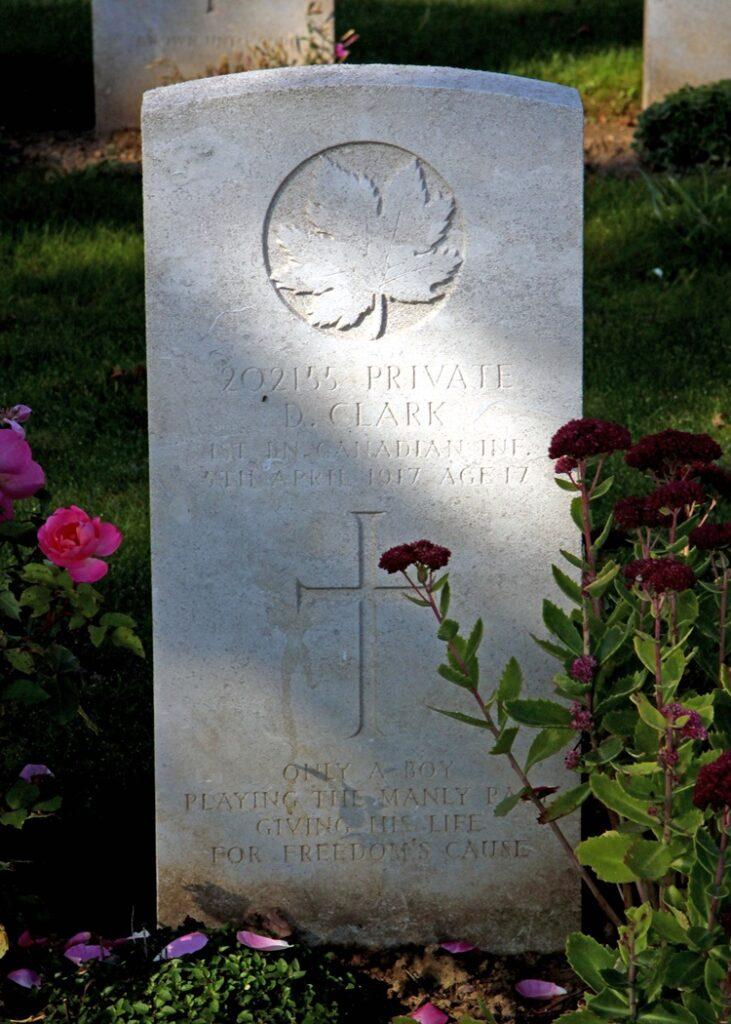
In the chaos of war, Douglas was initially buried on the battlefield under a cross that read “Unknown Canadian Soldier.” A few years after the war, he was reinterred at nearby Nine Elms Military Cemetery and his identity confirmed. Engraved on the headstone were these words: “ONLY A BOY / PLAYING THE MANLY PART / GIVING HIS LIFE / FOR FREEDOM’S CAUSE.”
ALEXANDER CLARK, my grandfather, rarely talked about the war. He had returned home physically unscathed. But the psychic wounds of guilt and grief ran deep. Alexander was tormented by the belief that, had he not intervened, Douglas might have survived the war.
And yet he got on with life back in Toronto, finding work at the Continental Can Company, where he would become a union organizer. He married Agnes Scott in 1920 and started a family. Eight years after Douglas died, the couple had a son and named him in honour of the young soldier.
When the world went to war again, Doug Clark was just as eager to serve as his uncle had been. A year after his father refused his request to enlist early, Doug, now eighteen, joined the Royal Canadian Air Force. He was short, like his uncle, but strong and wiry from playing sports. He had curly brown hair and a ready grin.
Most of Doug’s training took place out west. He studied navigation, Morse code, meteorology and aerodynamics. He had a chance to become a pilot but chose to become a bomb aimer instead because it offered a faster route to the war. After four months of training, during which he dropped eleven-pound practice bombs from planes high above Manitoba, Doug was awarded the Air Bomber’s Badge.
But ultimately, the war ended before Doug could get overseas. His disappointment was likely matched by his father’s relief. This Douglas Clark would be spared the horrors of war and have a chance at a long, happy life. It must have occurred to Alexander that things might have turned out differently had he agreed to Doug’s early enlistment.
Upon his discharge, an air force evaluation described Doug as intelligent, capable and keen. He wanted to study engineering at university. His future looked bright.
A year later, Doug switched career paths and decided to become a teacher. After studying at the Toronto Normal School, he landed his first job in Aurora, north of the city, where he also played on the town’s Senior B hockey team. He then moved on to suburban Etobicoke, where he would spend the rest of his career, which included a promotion to principal.
While still a young teacher, Doug met a petite brunette named Irene Berta at Deer Lodge in Haliburton. They married in 1951 and a year later had a daughter, Valorie. In 1956, they bought their first house, a red-brick bungalow in Port Credit, just west of Toronto. They welcomed three more children into the world in the next seven years: me, my brother Ron and my sister Nancy.
Watching it all unfold was Alexander, proud father and doting grandfather. I’m hoping it brought him some peace before he died in 1962 at age 67.
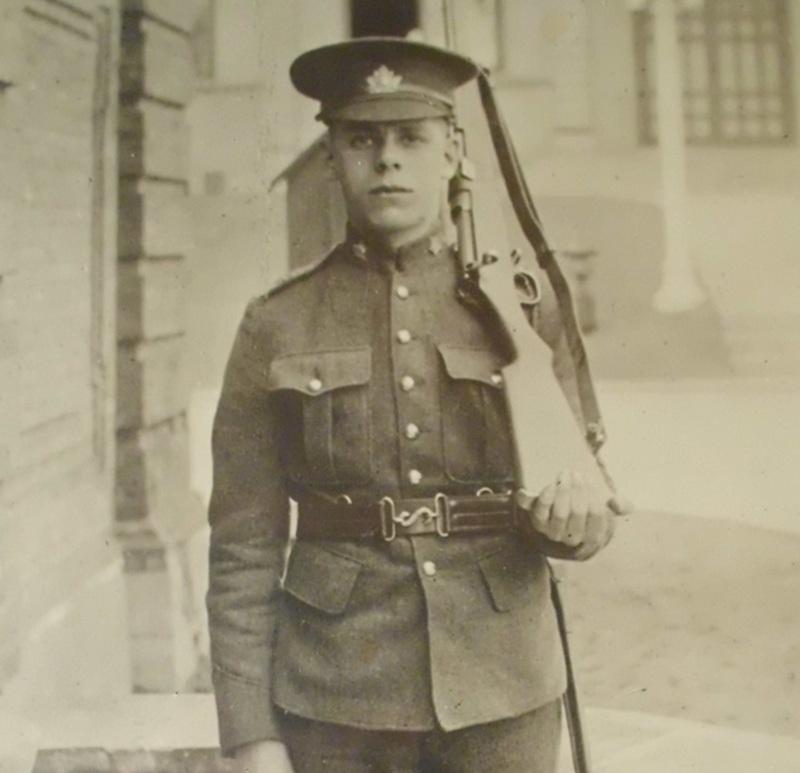
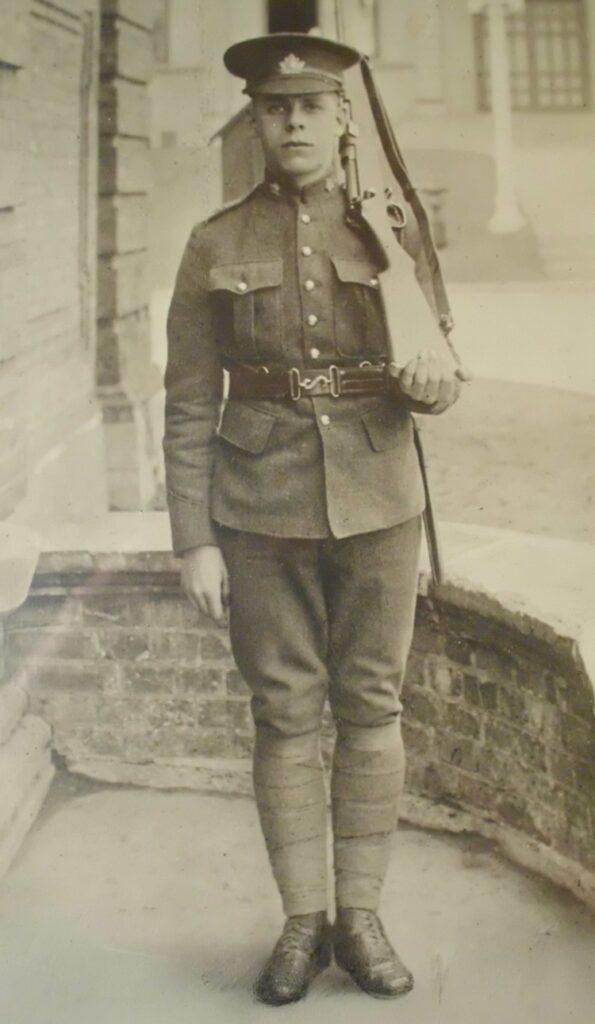
SET IN A CHIPPED WOODEN FRAME, a photograph of Douglas Clark, my great-uncle, sits on a shelf in my den. It shows Private Clark standing ramrod straight in his heavy woollen uniform and peaked hat. He’s shouldering a rifle using his left hand, his right hand hanging at his side. His hands and feet are small, even dainty. The earnest look on his youthful face is somehow heartbreaking. He’s a boy trying to look like a man.
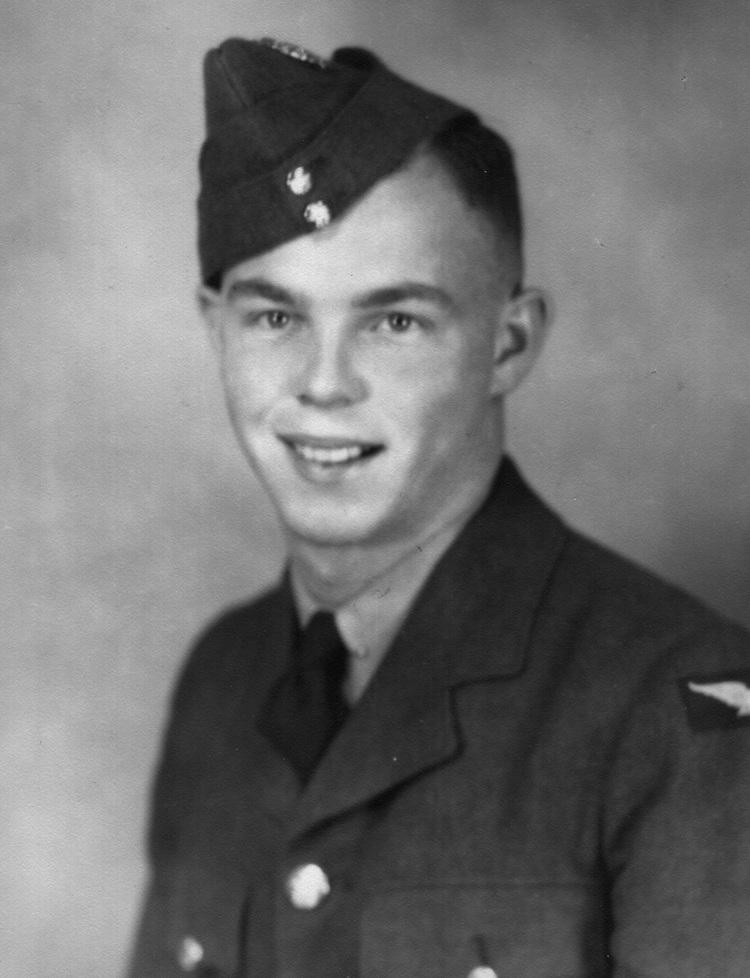
Sitting next to that photograph is a framed picture of my father in his uniform. There’s an eagle insignia visible on the left shoulder of his jacket. His black tie is done up neatly. He wears his cloth cap tilted to the right, as per regulations. His teenage face is animated by a wide grin and sparkling eyes.
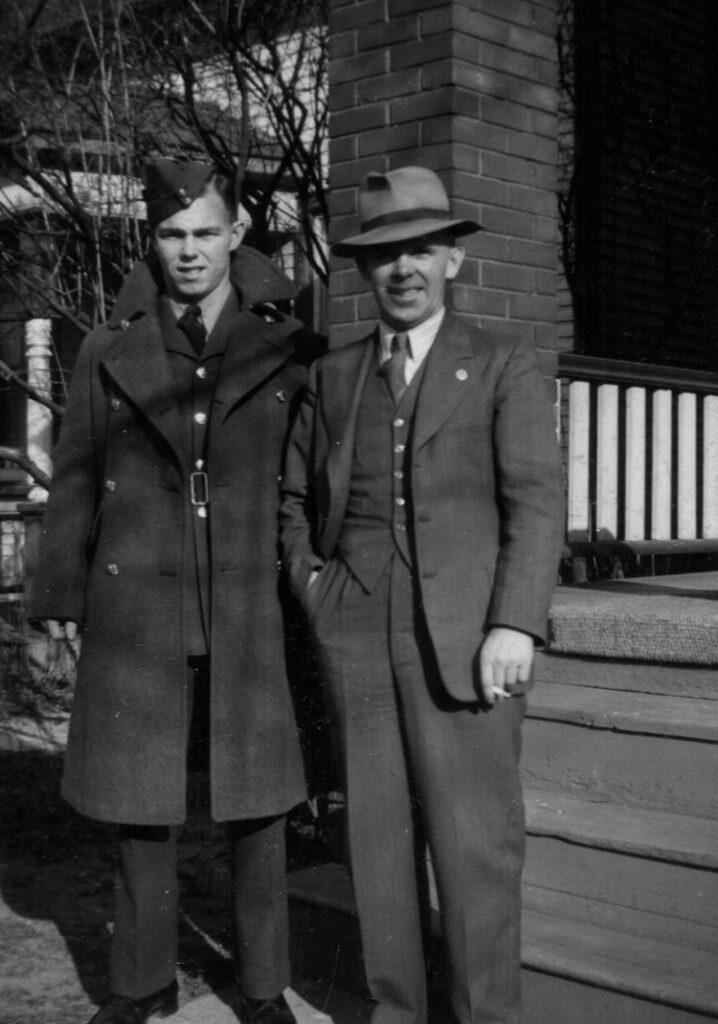
And there’s a third picture, also showing my dad, taken several decades later. He is surrounded by his family, including his two grandchildren, Mitchell and Madeleine. He had been retired for several years by this point, but had remained active. He and my mother travelled extensively, including tours of Europe. He skated and cycled well into his 80s. While on his bike, he would
occasionally ride no-handed, just to see if he still could.
In 2012, my father passed away at our Etobicoke home at the age of 86, his family by his side.

Brian Clark was born and raised in Toronto. He spent many years in the newspaper business, working as a reporter and a copy editor. Stops included the Toronto Star, Bermuda Royal Gazette and St. Catharines Standard. He continues to write, mostly fiction. He has had short stories published in Grain magazine, the Humber Literary Review, Untethered Magazine, the Spadina Literary Review and several other journals. Two of his stories were nominated for a Pushcart Prize. He has also completed a novel and a collection of fictional ghost stories.