
SECURITY AT PUFFIN Luxury Rentals is no laughing matter: the new contract covers all four buildings in closed-circuit video and includes a daytime patrol (one guard, one gate attendant) and a nighttime patrol (one guard), to the tune of $20,000/month. Another $10,000 pays for a round-the-clock concierge and fresh flowers and mats on every floor. Tenants living here expect no less; otherwise they’d live somewhere else.
Once a month, the party room in Tower C is booked for a two-hour staff meeting to discuss property maintenance and security. There’s the usual review of procedures – fires, floods, blackouts – and then the interesting stuff: a full updated list of persons to be refused entry to all buildings. Some of these are former employees, disgruntled in some way; some are distributors of religious pamphlets or junk mail, and some (the most interesting batch) are personal enemies of tenants, who’ve done something the superintendent believes is worthy of a permanent ban. The infractions themselves are not described in detail; only the offenders’ names and physical descriptions, photos (if available), and contact information for the complainants.
Philip, the daytime concierge and a twenty-year Puffin man, watches these with special attention. Anyone wishing to make trouble in his building must get past him or his colleagues, and Philip has a perfect memory for names and faces who’ve managed it over the years.
One such troublemaker: Alfred Rodriguez, mid-fifties Latino male, approx. five feet eight inches; a grainy photo taken from the security feed in the vestibule of Tower C; complaint registered by William Rodriguez (unit #306).
Philip prefers to keep speculation to a tasteful minimum. A concierge knows his tenants, after all – their favourite desserts, their preferred holiday greetings, their dreams – and takes no pleasure in their suffering. No such discretion should be expected from the security guards, who come to these meetings loaded with vulgar remarks and smelling of chicken wings.
“Same last name,” says one guard. “Bet they’re brothers. Willy owes Alfy money.”
“Father and son, maybe,” says another. “We don’t know the tenant’s age.”
Philip knows Bill’s age (fifty-four; fifty-five in March) but is not about to divulge it.
Another offender: mid-twenties white female, name unknown, described as “extremely disrespectful”; grainy photo of a woman holding a SkipTheDishes bag; complaint registered by Beatrice Pendleton (unit #104).
Dana the security supervisor, a small and frighteningly blunt woman, has been around long enough to know a few faces, and remarks, “Old Pendleton probably slid two nickels under the door as a tip and got an earful.”
Philip has to admit that that might be true. Older tenants, especially those living alone, sometimes become fixated on the idea of intruders. Food delivery people, Canada Post employees, FedEx drivers – all are capable of duplicating the anthrax attacks of the early 2000’s, and Ms. Pendleton does not take chances.
The final complaint comes courtesy of unit #288, and the meeting is brought to a halt by its contents.
The offender’s name: Bell Rogers. Mid-twenties white male. Two photos: a grainy one from the security feed, and another, professional-looking photo, likely taken from social media, showing the suspect posing in a pink tracksuit in front of the DeGroote School of Business. An occupation is listed (“DRUG DEALER, VERY DANGEROUS”), along with a list of alleged offences unlike anything the assembled staff has ever seen, apparently provided by the tenant.
Attention: This man throws sand at my window every night and claims I owe him money for drugs I never took, I DON’T DO DRUGS. Claims to study business but is only there to sell drugs and talk about weapons he owns. Please have Security look for sand or sand residue in the grass around Tower B because these are the only traces he leaves behind. He is very crafty and will evade authorities. Please help me, I’m not a bad person.
The humming of machines is the only sound in the room for a moment. The projector, the fluorescent lights.
“A drug dealer,” says one of the security guards, “named Bell Rogers.”
Another stretch of silence hammers the point home: this is not a prank or a joke, and a room full of professionals is being asked to take it seriously.
“Do we think,” someone says tentatively, “that his middle name could be Telus?”
Some restrained snickering among the security guards is the start of a chain reaction – soon everyone is chuckling, even the superintendent seated at the head of the table.
“Koodo, maybe?”
“Fido.”
“They call him Bell because he over-charges. They call him Rogers because his customer service sucks.”
“Low quality drugs, but he’s the only game in town so you have to buy from him.”
“He loves selling drugs to Toronto and Vancouver, but you can’t get him to go anywhere north of Timmins.”
Soon the ridicule becomes more than Philip can stand. It’s not that he doesn’t want to smile; he’s biting his inner cheek to prevent it – but his respect for his tenants is paramount. More to the point, there isn’t a single tenant living in a Puffin residence paying less than $4500/month, and some of them are powerful people. It’s good practice not to be seen laughing at their expense.
“Shameful. Shameful,” Philip roars. The rushing pink of his complexion matches the rose gold buttons of his uniform. “One of our tenants is being intimidated. They’re scared of what this Bell Rogers might do, and they’re asking for our help.”
“We’ll loan out a bulletproof vest,” says Dana. “Should do the trick against handfuls of sand.”
Badly outnumbered, Philip sits down and establishes a wall between himself and his coworkers with body language. Anyone watching from outside the room would surely know that something obscene was being discussed in there and that Philip was not part of it.
Unit #288. Sometimes it takes a moment with newer tenants, but Philip does remember him. Gabriel Aquino. A young student living alone. The most wonderful head of hair: tousled, spritzed with sea salt and dried to perfection like the crown of a California surfer, except Gabe’s is jet black and shimmers with snow through the winter. The hair is a sticking point with the boy’s parents, who visit twice a year, once at Christmas and once during the Filipino Holy Week. The parents are well-dressed and stern, quite comfortable criticizing their son in earshot of the concierge desk.
“The money we send. You can’t afford a haircut?”
“If you don’t care about your appearance now, how will you look when you’re forty?”
The normal thing for a young man under these circumstances might be to lash out, but Philip gathers that the boy is taking many factors into account. There are perks to having well-to-do parents, including lavish Christmas gifts and luxury apartments. Rather than open rebellion, Gabe prefers to live a parallel life that his parents know nothing about. One Gabe goes to business school and wears a collared shirt for his mother and father; another Gabe wears sweatpants and comes home drunk from Hess Village with his friends. Video games seem to play some part in this second life, as well: one of Gabe’s sweaters identifies him as an award-winning streamer, someone who plays video games professionally for an audience on the internet. Philip doesn’t understand much of this, but he remembers the answer he got when he asked Gabe to explain it.
“My team is in the top 0.1% in North America,” said Gabe. “Bangalore main, but I play Wattson and Crypto to keep me loose. Local tournaments are a joke at this point, but if we win Toronto in September, something will happen for us. A new sponsor, maybe, or I’ll get scouted for a pro team. Something.”
Had Philip simply nodded wisely and left it at that, he might have earned the young man’s trust. Instead, he asked a foolish question.
“And which game is best?”
“Which game?” said Gabriel dubiously.
“Of the ones you mentioned. Bangalore, Wattson, and Crypto.”
“The game is Apex Legends. Those are three of the characters you play.”
Philip, finally dispensing the wise nod he’d been saving, said, “I’m sure you picked the best ones.”
Gabe clenched his jaws and excused himself, and Philip came to understand something about the young man’s predicament. There’s nothing easy about a double life. Gabe has probably spent hours rehearsing the conversation with his parents where he comes clean: he doesn’t want to finish business school; he doesn’t want to cut his hair; he’d rather follow a dream. Perhaps he doesn’t have the sort of family where such a conversation is possible. But if it were possible, one of the ways he might prepare is by explaining his dream to someone neutral, someone of the same approximate generation as his parents – a concierge in the building where he lives, for instance. And if he couldn’t get a neutral third party to understand, what hope was there of persuading his parents?
Philip failed Gabe at a crucial moment, he’s sure of that. Since then, they’ve exchanged only brief greetings at the front entrance. Philip once provided a spare key for unit #288 to an intoxicated Gabe who was bawling uncontrollably. There’s no telling what a troubled young man might do if he decides that nobody understands him, and all this talk of drug dealers has Philip worried.
ON A HUMID THURSDAY MORNING, a man enters the lobby of Tower B wearing a Tiger-Cats cap. Philip has his suspicions right away, and a quick look at the list of banned persons confirms it: this is Bell Rogers. Tall, good-looking, and, despite having just walked into a new situation, absolutely certain of his right to rule. All he’s done for a disguise besides the hat is wear a different colour of tracksuit – powder blue.
“Delivering a package for Gabriel Aquino,” he says. He’s carrying no package, and nothing about his tracksuit indicates affiliation with a delivery company. It’s a poor performance, and somehow this makes Phil nervous. The young man expects to walk past the concierge desk one way or another, and if the delivery-boy routine doesn’t work he’ll move seamlessly to brute force.
“Well,” says Philip, pressing and holding the button beneath his desk. With any luck, security will respond quickly to the alert they’ve been sent. “Gabe may or may not be at home. But I can hold any packages for him.”
The eyes of Bell Rogers are like those of a grizzly – golden-brown, lazy, and indifferent to the pain of any victim. Philip presses the panic button an additional ten or twenty times.
“This needs to be delivered in-person,” says Bell Rogers.
“Ah,” says Philip. “You need a signature, you mean. That’s no problem. I’m authorized to sign for everyone in the building.”
Bell Rogers places both hands flat on the concierge desk.
Feeling he must say something, no matter how outrageous, to delay Bell Rogers, Philip asks the question he’s been contemplating for days:
“What does Bell Rogers mean? It’s a fake name, surely.”
There’s a pause while Bell Rogers absorbs this new information. His name and face are known; his arrival has been anticipated. This startles him at first, but he settles quickly on anger as his response.
“You decided to be stupid about this,” he says. “I didn’t decide. You decided.”
“It’s not the most conventional name,” says Philip weakly.
A handful of sand, apparently produced from somewhere in the tracksuit, is thrown in Philip’s face. But is it sand? Under the circumstances it’s impossible to rule out a deadly chemical compound (sulfuric acid? asbestos?), and Philip reacts accordingly. Howling, sputtering, trying to stand, Philip staggers face-first into a tremendous right hook thrown by Bell Rogers, and is deposited promptly back in his chair.
“You wanna know why they call me Bell Rogers?” says the young man, grasping Philip’s collar. “You wanna know?”
Another punch seems imminent, but it never comes. Philip opens one stinging, reddened eye, to see what the delay might be. Bell Rogers looms over him like a thunderhead, but seems to be waiting for something.
Of course. He asked Philip a question. Would Philip like to know where the name Bell Rogers comes from? Philip is being allowed space to guess. Perhaps if he guesses correctly, he won’t be hit again.
Philip needs to get this right. He begins by folding his arms. Bell Rogers’ grip on his collar has not relaxed, so Philip resembles a dangling fish, hooked through the gills and praying that good behaviour will result in a catch-and-release.
“Well now,” says Philip, chewing on a tablespoon or more of coarse grains (sand after all). “It’s a metaphor, of course. Rogers Communications and Bell Canada. They’re the next thing to a monopoly in this country. Regular people like you and me, we choose which of them gets our money, but there’s no option to give our money to neither of them. Not really. So the name Bell Rogers. It’s powerful. It means you’re in control of everything, from the grower to the dealer to the user. You’re the Bell Canada and Rogers Communications of the streets. Am I right?”
Bell Rogers’ expression makes it clear what he thinks of Philip’s theory: every word of it offends him. What’s more, he seems to have heard it before, and not just once.
“People and their bullshit,” he says. “Can’t fix stupid.”
“I think it’s a wickedly clever name. Wickedly.”
Philip is hoisted from his chair by the arm of a snarling, fuming Bell Rogers. The other arm is drawn back for a second, and likely final, punch.
“Tell your friends,” says Bell Rogers. “Tell everyone you meet. Bell Rogers is a fighter. He won a belt for boxing. That’s why they call him ‘Bell,’ because as soon as they hit that opening bell, he’s gonna ring yours.”
“Yes. Okay. That’s fine. What about Rogers?”
“Family name. And not the fucking cellphone company, either.”
Through tears, Philip pleads for mercy. “I’ll tell them. I’ll tell everyone. Please don’t.”
From somewhere behind Bell Rogers comes the sound of a retractable steel baton being shot to full length. Next a thumping noise as blows are repeatedly landed on Bell Rogers’ shoulders and back. Philip can see the baton flicking in and out of view from where he sits. At first Bell Rogers hardly seems to notice – wasp stings would be more effective – but the accumulated pain is eventually too great to ignore. Releasing Philip, Bell Rogers turns to face Dana the security supervisor.
“Stop that.”
“Stop hitting Phil,” says Dana. Defiant, in a wide stance, she looks ready for anything. Breathing hard through gritted teeth, she draws a threatening pattern in the air with her baton, which is only slightly bent after its heavy use in the last twenty seconds.
“I will,” says Bell Rogers. “I’ll stop hitting Phil.”
“Are we calm now?”
“Sure, I guess we’re calm.”
“Good,” says Dana. “Can you stay awhile and give a police report?”
“A report on myself, you mean.”
“It’s a chance to give your side of the story,” says Dana. “A lot of people don’t like how they come across on security camera footage.”
“I think I’ll go.”
“I’ll have to detain you.”
“If you hit me with that thing again,” says Bell Rogers, “it’s going up Phil’s ass.”
“I won’t use the baton unless you give me a reason.”
“You’ve got your security footage, and I won’t cause any more trouble once I leave.”
“Okay.”
“Okay.”
Nodding once to Dana and once to Philip, Bell Rogers walks through the vestibule and out the front door without a word. It’s as if he strolled into the building, was told that the address he wanted was actually two doors down, and strolled out again, perfectly calm.
Philip lies limply in his office chair, swiveling gently, while Dana talks with her superiors over the walkie and consults police over the phone. When this is done, Dana gives Philip a basic visual acuity test to look for signs of concussion.
“Jesus, Phil,” she says. “Are you alright?”
“You’ll never believe what he told me,” says Philip dreamily. Sweat and sand have formed a kind of cement on his forehead and cheeks.
“What did he tell you, Phil?”
“He told me what the name means. Bell Rogers. I’ve never heard anything so stupid in my life.”
GABE AND HIS TEAMMATES are sitting in his apartment. This is traditional before a big tournament, since Gabe is the only one with a car to reach the venue. Apex Legends is a game played competitively in three-person squads, and it would be difficult to find three better players in the country; you’d need to go to Toronto or cross the border to find talent like that. Their matching uniforms – black shorts and green t-shirts – bear the team name, VenomBleed, as well as the logos of various tournament organizersand the beef jerky manufacturer sponsoring the team.
They’re eating Thai food and watching gameplay footage of other professional teams. The last thing they’d do in the hours leading up to a tournament is actually play Apex: winning a few casual matches won’t affect their confidence, but losing a few might get in their heads. At their level of play, the people most likely to defeat them are themselves.
In a quiet moment, Gabe turns to his teammates and says, “There’s something I should tell you. I’ve been ghosting Bell Rogers.”
“They’ll just turn off your service,” says Lana.
“No, I’m talking about a person,” says Gabe. “A dealer.”
Tyler is snickering. “Bell Rogers? The tracksuit?”
“Who?” says Lana.
“Guy from Gabe’s program,” says Tyler. “Business student with a side-hustle.”
“Bottom feeder,” says Gabe. “Nobody movesquantities of stuff in Hamilton without permission from certain people, and he doesn’t have permission. His whole thing is being small enough that nobody notices him. It got me thinking. Once he realizes I’m not paying him, he’ll have to eat the cost. He’ll have to. He can’t make a big stink and risk certain people finding out he’s there.”
Lana, a psych student, is often the quiet one in the group – not because of any dislike or distrust, but because Gabe and Tyler share interests outside of Apex and sometimes talk a language of their own. Her contributions to discussions are generally questions, generally practical, often perplexed.
“So you bought some . . . stuff from this guy?” she says.
“Yeah,” says Gabe.
“How much do you owe him?” says Lana.
Gabe doesn’t answer right away. He drinks water. Lots of water.
“$500,” he finally allows.
Tyler’s mouth falls open. “Bell Rogers gave you $500 worth of ex on credit?”
“Not exactly,” says Gabe sheepishly. “I paid upfront for a big order, but I was $500 short. And now it’s nonstop harassment. He tried to get into my building the other day.”
“What happened?” says Lana.
“Punched out the doorman. Never got past the desk.”
“Jesus, Gabe,” says Lana. “Pay him.”
“You’ve never met this guy,” says Gabe. He’s looking at the ceiling instead of his friends, the better to conjure the demon he’s facing. “He’s the type who spends his whole life looking for situations where he’s the tough guy.His fifteen-year-old cousin has a birthday party and he’s the twenty-five-year-old who brings cocaine. He thinks he’s going to sell a bunch of weed to university students, coast through a business degree, and get rich in real estate. And nobody will stop him because nobody can deal with how toxic he is. That’s not me speculating – he says it all the time. Not paying him is a lesson. It’s a way of attaching costs.”
Lana, who’s been watching a game of Apex on her phone, finally finds it impossible to maintain her concentration. She closes the tab and turns to Gabe.
“I hear you. He’s a shitty person,” she says. “But he’ll leave you alone if he gets his money, and you have money.”
“I’m not one of those kids he can push like that. He’ll learn.”
With sheer stubbornness, Gabe has silenced the room. Tyler snickers nervously. The potential for a fight is in the air, if Lana will only call Gabe out.
“This is what we’ll do,” says Lana. “As long as we finish in the top six tonight, we’ll win $2500, minimum. If you put in $300 from your end, I’ll top you up to $500. You’re paying him, and I don’t want to hear about it again. I won’t have this hanging over our heads.”
It’s a little too clear now who the bad guy is, if Gabe says no to that.
“I’ll chip in 50 bucks,” says Tyler. “It’s the right thing, Gabe.”
Stuck on the losing end of a majority vote, Gabe adopts a sullen silence, a sullen posture. He leaves the room and stares at his reflection in the bathroom mirror. He pictures Bell Rogers. Bell Rogers boasting about his fifteen-year-old cousin and her friends trying coke because he told them to; Bell Rogers laughing at how easy it is to dominate people if you aren’t afraid of what they’ll say. Bell Rogers living his dream without any regrets.
Leaving the bathroom, Gabe barks a sullen reply: “Let’s go win the money before we decide how to spend it.”
This gets the squad moving: the remaining Thai food is consumed or disposed of; spare keyboards and mice are packed in a shopping bag, and shoes are put on. Gabe finds it difficult to look at the concierge on their way past the desk, so he keeps his eyes fixed in front of him. He’s seen the bruise across Philip’s nose and forehead, the colour of rotten plums.
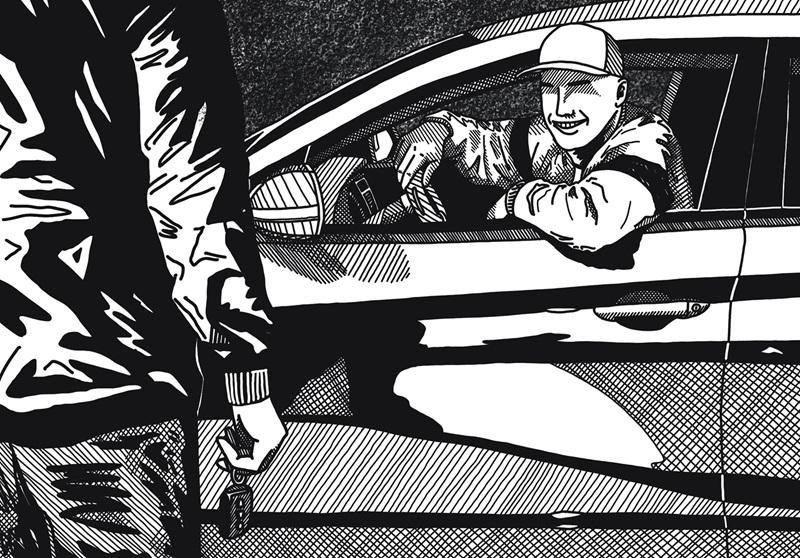
Parking spaces at Puffin Luxury Rentals are assigned, but the above-ground lot is so huge that people often pull into the wrong row by mistake. For this reason, it’s best to double-check you’ve found your car, rather than the same make and model belonging to someone else. Having done this, Gabe is certain the grey Elantra he’s approaching belongs to him. As he reaches for the handle, he locks eyes with the person already sitting behind the wheel. Bell Rogers.
The window slides down, allowing Bell Rogers to stick his head and arm out.
“My good friend Gabriel,” he says, grinning ear to ear.
“This is the stupidest thing you’ve ever done,” says Gabe. “There’s cameras all over the place.”
“Bell Rogers is no stranger to cameras being on him. Inside the ring or out.”
Reminding himself there’s only one thing these guys understand, Gabe starts shouting directly in Bell Rogers’s face. “Where are you going to fence a stolen car? It’s thinky thinky time, Bell Rogers. You’re not one of the people who gets to steal cars in Hamilton. You’re not part of the network. If you drive this thing into a chop shop, they’ll take you apart and sell you for scraps.”
Doubling down on the strategy of making a scene, Tyler approaches the window and starts shouting, too.
“Go ahead! Gabe will just file an insurance claim and get a new car.”
“Who’s talking to you?” says Bell Rogers.
“Best-case scenario, you get to ride around for a day or two before you park it on the street or light it on fire,” says Gabe. “Multiple felonies. Sound good to you?”
“Not if you hand me the keys,” says Bell Rogers. “Then it’s a gift. We’ll finally be squared up.”
“A $28,000 vehicle on a $500 debt,” says Gabe. “You’ve never had any idea what you’re doing, but this is really special.”
Lana, having kept her distance until now, approaches the window and speaks directly to Bell Rogers: “The cops are coming, I called. Let’s be real. If you get $500 right now, will you leave Gabe alone?”
“You could say it’s gotten personal. Let’s say $2000 total, plus an apology.”
“Let’s go,” says Gabe to his teammates. “We don’t have time for this. We’ll take the train.”
“Good luck tonight,” calls Bell Rogers. “Click fast. Click hard. Click click click.”
GABE HAS AN OUTBURST on the train platform, smashing his fist into an aluminum trash bin, but by the time the train arrives he is calm, watching Apex on his phone, and showing noteworthy clips of the action to his teammates. Lana and Tyler are suspicious of this instantaneous recovery and are watching him closely. They seem to be bracing for some kind of delayed breakdown.
“We can cancel the tournament,” says Lana, “if you’re not up to it.”
“We’d do that for you,” says Tyler. “It’s okay.”
They don’t understand. Gabe has almost forgotten the confrontation. He can scarcely put into words how little he cares for the car.
“Comprehensive auto insurance is a beautiful thing,” he explains. “I’ve been wanting to trade it in for years.”
And he’s certainly not about to forfeit the biggest tournament of his life over the Elantra.
More than that, Gabe has crossed a threshold. His problems are forced to wait at the door of the calm temple where he now sits. What this temple is, exactly, might best be compared to the place a concert pianist gets to, once he’s sitting at the keys. The pianist might have any number of personal problems, but his reward for returning to the piano after another day or week in the world, with all its horrors, is bliss. The professional Apex player is no different, when he’s found his flow-state.
The venue is stunning. One of Toronto’s mid-size arenas has been modified for e-sports events so the audience’s attention is drawn to giant screens at centre-stage. A bank of spotlights, imitating a progress bar, moves along the executive boxes high above the audience, where the actual games are played. In places like this, where thousands gather to watch contests between giants, Gabe is a giant; a prince-in-waiting. He takes in the sights and sounds, aware that life will not get better than this. These moments must be chiseled into his memory with the kind of precision that will keep them legible in his old age.
IT’S TOO MUCH INFORMATION for Gabe to process, so for almost five minutes, he doesn’t try. He holds onto his teammates in a desperate hug while the music and the lights wash over them.
A sixth-place finish would have secured them $2500; it would have proven to the community that even if Toronto held most of the cards, Hamilton held an ace; it would have bloodied the noses of naysayers and put VenomBleed on the map.
They finished third. Within two business days, $8000 will be e-transferred to an account of their choosing. They’ve been officially invited to the winners’ afterparty in the VIP lounge. And in the final moments of the match, when Gabe’s character was killed and Lana and Tyler were scattered, a tournament representative discreetly slid a business card onto Gabe’s desk. The card belonged to a member of the marketing team at a microchip company, dealing with sponsorships. Noticing that similar cards were not issued to his teammates, Gabe quickly slid his into his pocket.
“I’m proud of us,” says Gabe.
“I bought my first laptop,” says Lana, gasping for air, “saving my birthday money, Christmas money. And now we’re here.”
“We have to promise each other,” says Tyler, “to stay together. We’ve made it this far.”
“I’ve never had to pee so bad in my life,” says Lana.
“Me neither,” says Gabe. “Meet back here in five minutes?”
“Don’t worry,” says Tyler. “I already went in my pants in Game 2.”
Gabe and Lana walk together out of the executive suite and down the hall to the washrooms, diverging at the signs for Men and Women. Alone, Gabe smirks in the mirror: a prince indeed.
At almost the same moment, two things happen: Gabe raises the lid of the toilet in his stall, and someone kicks the door open behind him.
Someone grabs the back of Gabe’s neck and pushes him forward, causing him to fall onto the porcelain toilet tank cover. Gabe braces himself with one hand, a reaction that probably saved several of his teeth.
The attacker adjusts his footing and pins Gabe in place. This is all done calmly.
A large pocketknife is produced and the blade is laid gently across the back of Gabe’s fingers on the toilet tank.
“Jesus, no,” says Gabe.
Next the attacker does something clever. It takes several minutes for Gabe to figure it out, and by then everything has already happened. Gabe’s neck is wrenched towards the ceiling so that he can’t see what’s being done to his hand. Then the knife, which was pressed blade-down into Gabe’s fingers, is flipped over, dull-side down. With the application of a small amount of force and a sawing motion, the attacker is able to give Gabe the impression that his index finger is being removed, without actually harming the finger.
“Best wishes from Mr. Bell Rogers,” says the attacker, loudly enough to be heard over Gabe’s wailing. He’s a tall, heavyset man, judging by the voice.
“Please, no!” says Gabe.
“How much do you think I get paid for something like this?”
“I don’t know,” says Gabe.
“You’re about to learn how the sausage is made. $3K upfront, $3K when I bring home the finger in a plastic bag.”
“No!”
“But I usually make an offer in this situation.”
The grip on Gabe’s neck remains strong, but the knife is put away; Gabe can breathe a little easier, think a little more clearly.
“Guys like Bell Rogers,” the attacker continues. “They’re the reason for my grey hairs. Twice a week I’m chasing guys like him because they haven’t paid somebody. And still it’s a-mile-a-minute with the big gangster talk.”
“Yeah,” says Gabe. Sensing an opportunity to establish common ground – the kind that might prevent the loss of his finger – he adds, “I always knew Bell Rogers was nobody. He’s not connected, is he?”
“His mouth’s connected to his ass. That’s as far as it goes.”
“Was he wearing the tracksuit?” Gabe ventures.
“Was he ever. Seemed like he just came from the beach or something. Kept leaking sand out of his pockets, like loose fucking sand in his pockets.”
“And he told you about his nickname, I bet. He loves that.”
“Bell fuckin’ Rogers. He tried haggling me, and I just kept telling him I’m happy with my long-distance carrier. He didn’t like that, but he knew better than to say it.”
Gabe manages to laugh despite being scared shitless. A lighthearted demeanour seems to be called for.
“Here’s how it is,” says the attacker. “I’m a simple guy. Someone off the street gives me $3K to do something, and someone else gives me $3K not to do it, I go home happy.”
“I don’t think I can get $3000 at an ATM all at once,” says Gabe.
“E-transfer. Open your banking app and I’ll tell you where to send it.”
Gabe does what he’s told, step by step, until $3000 is confirmed to have left his account. All this time, his head and arm are held in place.
“It could take fifteen minutes to clear the bank,” says Gabe.
“Hope you’re comfortable, then.”
Gabe groans. The adrenaline is wearing off, so there’s nothing to prevent his neck and shoulders and fingers from fully experiencing the agony of the next fifteen minutes. This is made worse by the attacker’s attempts to continue a casual conversation.
“I never knew this was a real thing. Playing video games for money. Could my kid do this?”
“If they work hard,” Gabe croaks.
“You should see how hard she works, as long as it’s an Xbox achievement. Anything else, forget it.”
Gabe is refreshing his email notifications twice per second, waiting for the bank to send him confirmation of a successful deposit. The first 1000 attempts are in vain. An email from Gabe’s soap subscription service fills him briefly with hope, then with despair. When confirmation finally arrives, the attacker gives Gabe some final instructions for bringing this encounter to a peaceful end.
“Put your phone down. Look at the wall in front of you and count to 100. Don’t turn around, don’t touch your phone. After you hit 100, you’re free to go. Stay in school.”
Gabe counts to 150. He needs the extra time to compose himself. No sooner has he finished counting than his phone starts vibrating, announcing an incoming call. Some part of him believes it’s the police, calling to tell him they’ve been monitoring e-transfers in Gabe’s area for months, looking for the man who just attacked him: the criminal has been apprehended, and Gabe’s money is safe.
It’s not the police, of course; it’s Gabe’s father. And because there’s nobody who could be less useful to him right now, Gabe ignores the call.
The calls keep coming, however, and it finally occurs to Gabe what must be happening. It’s the money. Large transfers out of Gabe’s chequing account are automatically flagged by the bank – part of an arrangement to limit Gabe’s spending – and nothing happens in this account without Gabe’s parents knowing.
“Hey dad,” says Gabe wearily.
“We’re watching Mad Men and my phone starts going crazy. What did you do?”
Gabe sits on the toilet and pinches the bridge of his nose – a position he maintains throughout the conversation.
“Dad, everything’s fine. Nothing to worry about.”
“That’s terrific. Now where did 3000 Canadian dollars just go?”
It’s the end, finally. There’s no lie he can tell to explain the disappearance of so much money. All that’s left is the truth, which will damn him worse than any lie: Gabe won some money on the professional gaming circuit – something he’d sworn many times to stop doing – and then he lost it all in a dispute with his drug dealer. Gabe might as well kiss his freedom goodbye.
“Well?” says his father.
Of course, there is one lie he can tell. And his father will believe it, too. The problem is that Gabe will have to start living this lie, to some extent, once it’s been told.
“Dad, I’m starting a business.”
Dead silence on the other end of the line: a long, revealing pause. Gabe’s father knows he’s being manipulated, or at least suspects it, but he’s also been waiting to hear these words all his life.
“Oh?” he says suspiciously. “What sort of business?”
Gabe is exhausted, and all he can do is say the first thing that comes to mind:
“Telecommunications.”
“Telecommunications?”
“Yeah. I’ve already got a computer science guy – he knows networks and things. All we need is somebody in the trades to put up towers. $3000 was for some
equipment and legal advice.”
“Put up towers,” Gabe’s father repeats. “Gabe, this isn’t a business you just jump into.”
“That’s what the paralegal said. But I wasn’t going to give up until I tried a few more things.”
“It’s not a matter of trying a few things, Gabriel. Not in Canada. They’d eat you up, Telus and Bell and the other one. Even if you got something off the ground, they’d sue over every little thing until you went broke defending yourself in court.”
“You’re probably right,” Gabe admits.
“I don’t want to discourage you altogether. Your impulse is right. You just need to choose the right industry. We should talk.”
“Okay,” says Gabe. “But later, okay? I have some calls to make.”
“Good. Important calls. We’ll talk later. Your mother’s here. She wants to say we’re surprised to hear you talking this way, but we’re proud of you.”
“Yeah. Bye.”
Gabe scrubs his face with cold water and staggers out of the bathroom, returning to his friends in the executive box.
“Everyone else is at the afterparty already,” says Lana, annoyed by the delay.
“We’re the bronze medalists,” says Tyler. “We’re rich!”
“One drink,” says Gabe, “and then I’m going home.”

Eric Rausch grew up in north-central Saskatchewan and earned a Bachelor's degree in English from the University of Saskatchewan. His work appears in Prairie Fire, The Humber Literary Review, and Existere. He lives and works in Hamilton, Ontario. www.linktr.ee/rauschwrites