
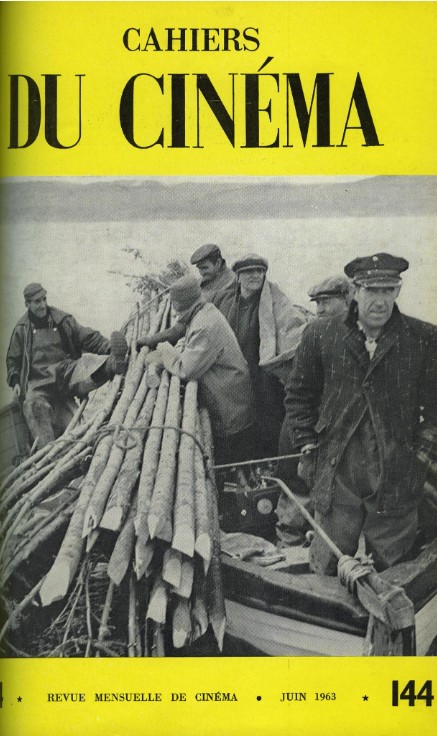
CAHIERS DU CINÉMA is France’s oldest film magazine. Here we have included an excerpt from issue number 144, published in 1963, which contained an interview with Jean Rouch. Jean Rouch is considered one of the founders of cinéma vérité in France, and in this interview he talks about the influence of the National Film Board of Canada and Quebecois filmmakers on French cinema.
This excerpt ties into this issue’s history piece. For more information on the history of Canadian film, check out “Canadian Classic” at the beginning of this issue.
Credit: Eric Rohmer and Louis Marcorelles, “Entretien avec Jean Rouch,” Cahiers du Cinéma 144 (1963): 16-18.
THE NATIONAL FILM BOARD, in Canada, arouses our curiosity. What is this organization? What are its goals, its spirit, its work?
The National Film Board is a wartime creation. It got off to a flying start in animation, thanks to McLaren. Then came a series of moderately good documentaries – truth be told – but ones that allowed people to build film crews. They often shot in 16mm, because it was cheaper and because many of the films were intended for non-commercial circuits or television.
The National Film Board was one of the first cinema – not television – organizations to work in 16mm. This led to the training of top-tier crews, and above all technicians. A key contribution came from British-Canadian technicians, who are meticulous people and who were the only ones to push 16mm to its limits, treating it as a professional tool and demanding standards befitting cinema, not television.
The second point was that, under this British influence, a kind of film school was created within the organization where technicians were recruited, and quite quickly it was realized that it was interesting to bring in French-Canadian technicians, who had ideas and an artistic sensibility that many British Canadians lacked. If the National Film Board was moved from Ottawa – where I believe it was originally based – to Montreal, it was precisely because it was deemed necessary to place this cultural institution within French Canada.
So it came to exist, about ten years ago, in a French-speaking country: a production organization in 16mm that possessed the qualities of English-language organizations – that is, the meticulous, rational English approach – but also the French spirit. Recruitment at the Film Board was based on qualifications, which had nothing to do with graduating from IDHEC or a film school, but rather with having actually made films. People of all backgrounds were hired, because they wanted to make cinema, because they were passionate about it, and because they had made amateur films – they had proven themselves.
The collegiate spirit had one interesting effect: the people working within the Film Board form a team, and this entire team is invited to the rushes whenever one of its members is shooting a film. They give advice, critique, or conversely, are asked for advice, are encouraged. In other words, something exists there that can hardly be found anywhere else: complete creative freedom. Everyone collaborates on a shared work, they critique one another, argue, and so on – but it’s enormous. All of this would be theoretical and worthless if there were no results.
It must be said, all that we have done in France in the area of cinéma vérité comes from the National Film Board. It is Brault who brought a new technique of filming that we had not known and that we copied ever since. In fact, truly, there is a “brauchitis” spreading, it is certain. Even the people who consider that Brault is a nuisance, or were jealous, are forced to recognize it.
THE FIRST COLLECTIVE FILM of the Film Board where everyone was stimulated [was] Days Before Christmas (Bientôt Noël). That was when they first attempted direct synchronized sound, in the street, anywhere. Wolf Koenig was at that time working alongside a group of fellows named Michel Brault, Georges Dufaux, Claude Jutra. Tom Daly, head of one of the English-language teams, ran the rushes. No one arrived more than five minutes late, sometimes up to an hour before the screening. It was then that Brault presented one of the most extraordinary shots anyone had seen: a tracking shot starting from a bank vault being closed, following a detective’s gun as he escorts the money all the way to the armored car where it is deposited. Upon seeing this shot, people fell off their chairs, saying: “That’s what we need to do.” This was truly a revolution at the Film Board. Everyone said: “We want to do the same thing.” They started walking with a camera, whereas until then, no one dared shoot without putting the camera on a tripod, no one dared expose metres and metres of film without having an established shooting plan. They employed the Cartier-Bresson method – that is, the hunt for images. This dates from 58–59.
A very interesting phenomenon occurred: the English-language crews … lost interest in this approach. The French team, however, threw itself into it wholeheartedly.
WHEN I MET BRAULT for the first time, it was at a Flaherty seminar in 1958, in Santa Margarita, California. I had seen Les Raquetteurs, I had seen Bientôt Noël, Brault had seen Moi un Noir which I presented there. We got along well, and I decided to invite him to France to shoot Chronique d’un été. He arrived here and turned everything upside down. The first shot we filmed with him was the shot in the Place de la Concorde – Marceline’s shot. When we watched her walk alongside him, with the camera twenty centimetres away, I said to myself: “What is this going to give us?” – and it was there that we all learned this method of walking with a mobile camera, with a very wide-angle lens. Brault then worked with Ruspoli, in Lozère – not without stirring a certain jealousy among French cameramen, which is normal – and then Pierre Lhomme took up these techniques, adapted them.

Cahiers du Cinéma is France’s oldest film magazine.